
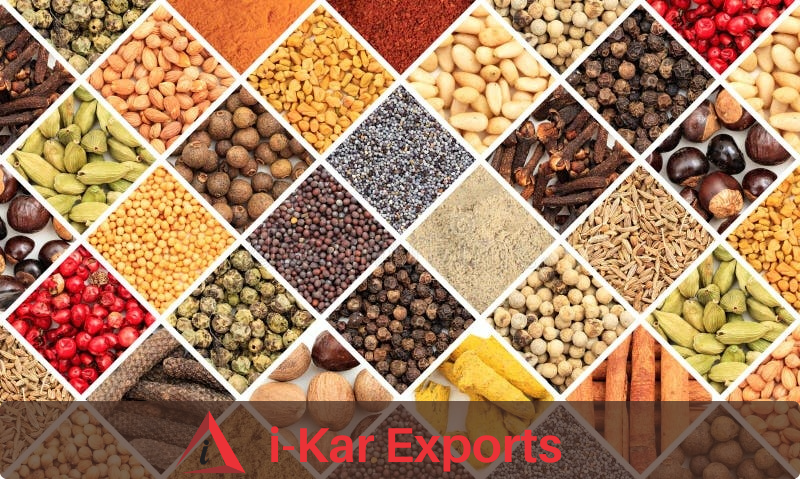
India’s spice export industry — the world’s largest, covering over 180 countries — is going through a wave of regulatory change in 2026. From new certification requirements in the UK, to fresh EU advisories, to fallout from the 2024 ethylene oxide contamination cases, exporters and buyers alike need to stay current. Here’s a breakdown of the latest policies shaping spice exports from India, and what they mean for anyone sourcing through an exporter like i-Kar Exports.
1. The SPICED Scheme (2025-26)
In May 2025, the Spices Board of India launched the SPICED Scheme — Sustainability in Spice Sector through Progressive, Innovative and Collaborative Interventions for Export Development — <cite index=”1-1″>funding productivity enhancement at farm level, technology adoption, quality upgradation to meet international food safety standards, and market promotion for Indian spice brands abroad.</cite>
For buyers, this means exporters investing in SPICED-backed upgrades are more likely to offer better traceability, improved lab infrastructure, and stronger compliance with international food safety benchmarks going forward.
2. New UK Certificate Requirement (Effective January 1, 2026)
One of the most important recent changes affects exporters shipping to the United Kingdom. <cite index=”6-1″>The Spices Board has issued a trade advisory on the requirement of an official certificate for export of spices and spice products to the United Kingdom, effective from January 1st, 2026.</cite>
Any exporter shipping spices to UK buyers — including i-Kar Exports — must now ensure this official certificate accompanies every shipment. Buyers in the UK should specifically confirm this document is part of their supplier’s standard documentation set.
3. EU Advisory on Mineral Oil Aromatic Hydrocarbons (MOAH)
The European Union has tightened its food safety scrutiny further. <cite index=”6-1″>The Spices Board has issued an advisory on proposed Maximum Levels (MLs) for Mineral Oil Aromatic Hydrocarbons (MOAH) in spices and spice products exported to the European Union.</cite> This is a newer contaminant category (alongside pesticide residues and aflatoxins) that EU-focused exporters now need to test for and monitor.
4. Market Access Update for China
<cite index=”6-1″>China has granted market access for the export of ground spices from India, per a Spices Board circular.</cite> This opens a significant new opportunity for Indian exporters — including chilli and turmeric suppliers — to expand into the Chinese market, provided they meet China’s specific import compliance requirements.
5. Post-2024 Quality Reckoning: Ethylene Oxide & FSSAI Testing
The industry’s compliance culture shifted sharply after 2024, when <cite index=”7-1″>Singapore and Hong Kong recalled certain major Indian spice brand products over ethylene oxide contamination concerns, prompting FSSAI to order nationwide testing of spice manufacturers.</cite> The result has been a lasting emphasis on documentation discipline — <cite index=”7-1″>wholesalers and exporters are now expected to maintain audit-ready records rather than treating compliance as a paperwork afterthought.</cite>
For buyers, this means it’s now standard — not optional — to ask any exporter for recent third-party lab reports covering pesticide residue, aflatoxins, and sterilization method (steam sterilization is generally preferred over ethylene oxide fumigation for export-grade spices today).
6. Country-Specific Import Requirements Buyers Should Know
Beyond India’s own export rules, the destination country’s import requirements also apply:
- USA — <cite index=”5-1″>FDA Food Facility Registration and Prior Notice are mandatory for each food shipment, including spices.</cite>
- European Union — <cite index=”5-1″>TRACES NT notification is required for many food products, with strict enforcement of Maximum Residue Limits (MRLs) for pesticides; non-compliance can trigger rapid alert rejections.</cite>
- UAE / Saudi Arabia — <cite index=”5-1″>Halal certification is often required, along with additional conformity documents such as ESMA (UAE) or SFDA-linked certification (Saudi Arabia).</cite>
7. Registrations Every Legitimate Exporter Must Hold
Regardless of new policy updates, the baseline registrations required to legally export spices from India remain:
- IEC (Importer-Exporter Code) — issued by the DGFT, required to export or import anything from India
- Spices Board RCMC / Exporter Certificate — mandatory registration under the Spices Board Act before any spice shipment can leave India
- APEDA Registration — relevant for grains, pulses, and other processed agri-products
- FSSAI License — the baseline domestic food safety license
Buyers evaluating any exporter — including i-Kar Exports — should request these registration numbers directly as part of due diligence.
What This Means for Buyers Sourcing Through i-Kar Exports
With policy shifts touching UK certification, EU contaminant limits, China market access, and post-2024 quality expectations, working with an exporter that stays current on compliance is now more important than ever. i-Kar Exports, sourcing red chilli, turmeric, ginger, garlic, onion, pulses, and grains from Rajasthan and Guntur, operates within this same regulatory environment — and buyers are encouraged to confirm current registration and certification status directly before placing bulk orders.
📩 Email: support@shalasetu.com 📱 WhatsApp: +91-9988469468 🌐 Website: http://ikarexports.com
Frequently Asked Questions (FAQ)
Q1. What is the new UK certificate requirement for Indian spice exports? Effective January 1, 2026, an official certificate is required for the export of spices and spice products from India to the United Kingdom, as per a Spices Board trade advisory.
Q2. What is the SPICED Scheme? SPICED is a Spices Board initiative launched for FY 2025-26 that funds farm-level productivity upgrades, technology adoption, food safety quality improvements, and international market promotion for Indian spice exporters.
Q3. Has China opened its market to Indian spices? Yes, China has granted market access specifically for ground spices exported from India, opening new opportunities for exporters in this category.
Q4. Why did ethylene oxide become a major compliance issue for Indian spice exports? Following 2024 recalls of major Indian spice brand products in Singapore and Hong Kong over ethylene oxide contamination, FSSAI ordered nationwide testing, pushing the industry toward stricter documentation and safer sterilization methods.
Q5. What registrations must an Indian spice exporter hold? At minimum, a legitimate exporter needs an IEC from the DGFT, Spices Board RCMC registration, and an FSSAI license; APEDA registration applies for grains and other agri-products.
Q6. What is MOAH, and why does it matter for EU-bound spice exports? MOAH (Mineral Oil Aromatic Hydrocarbons) is a contaminant category the EU is tightening limits on for spice imports — exporters shipping to the EU need to monitor and test for it alongside pesticide residues and aflatoxins.
Q7. How can I confirm an exporter’s compliance before placing a bulk order? Request their IEC, Spices Board RCMC number, FSSAI license, and recent third-party lab test reports directly — a transparent exporter will share these without hesitation.
Regulations affecting India’s spice export sector continue to evolve. This overview reflects publicly available Spices Board advisories and industry reporting as of mid-2026 — always confirm current requirements directly with the Spices Board or your customs broker before finalizing an import or export order.