India is one of the world’s leading producers and exporters of red chilli, supplying whole dried chillies, chilli powder, chilli flakes and other chilli products to food processors, spice manufacturers, wholesalers and importers across global markets.
The 2025–26 season has been an important year for India’s red chilli industry. Production estimates indicate a decline from the previous year, while chilli continues to remain India’s most important spice export by value.
For international buyers looking to source Indian dry red chilli in bulk, understanding India’s production, major growing regions, varieties, quality parameters and export market is essential.
India’s Red Chilli Production in 2025–26
According to the latest Spices Board of India spice-wise production estimates, India produced approximately:
- 2025–26 estimated chilli production: 2,464,180 MT
- Area under chilli: 785,680 hectares
- 2024–25 production: 2,694,838 MT
- 2024–25 area: 789,202 hectares
This means estimated chilli production in India declined by approximately 8.6% year-on-year, while the area under cultivation remained relatively stable.
The Spices Board notes that the 2025–26 figure is an advance estimate and is subject to revision.
The Directorate of Arecanut and Spices Development (DASD) has also reported pressure on dry chilli production, attributing the decline primarily to reduced area and production in Andhra Pradesh and Telangana, along with excess rainfall during sowing and pest and disease problems such as thrips and leaf curl virus.
Why Did Red Chilli Production Decline?
The 2025–26 chilli season faced several challenges.
1. Excess Rainfall
Excess rainfall during the sowing period affected chilli cultivation in some of India’s major producing regions. Water-related stress can affect plant establishment, flowering and overall crop performance.
2. Pest and Disease Pressure
Farmers in major chilli-producing states experienced pest and disease issues, particularly thrips and leaf curl virus. These problems can reduce both yield and marketable quality.
3. Lower Cultivated Area
The area under chilli cultivation in 2025–26 was estimated at around 785,680 hectares compared with 789,202 hectares in 2024–25.
Although the reduction in area was relatively small, weather and crop-health issues contributed to lower production.
Major Red Chilli Producing States in India
India’s chilli production is concentrated in several states, with Andhra Pradesh and Telangana being particularly important to the country’s dry chilli supply chain.
Andhra Pradesh
Andhra Pradesh is one of India’s most important chilli-producing and exporting regions, with Guntur serving as a major centre for chilli trading, processing and exports.
The Spices Board identifies Guntur Sannam S4 as a major Indian chilli variety. It is known for its thick skin, red colour and strong pungency, with harvesting generally taking place from December to May.
Guntur is also strategically important for exporters because of its established chilli markets, processing infrastructure and connectivity to ports such as Chennai and Visakhapatnam.
Telangana
Telangana is another major chilli-producing state and an important part of India’s southern chilli supply chain.
Production in Telangana, like Andhra Pradesh, was affected during the 2025–26 season by weather and crop-health conditions.
Karnataka
Karnataka is well known for varieties such as Byadgi chilli, which is particularly valued for its deep red colour and relatively lower pungency.
Byadgi chilli is widely used in spice blends, food processing, colour extraction and chilli-based products where colour is important.
Madhya Pradesh
Madhya Pradesh is also an established chilli-producing region. The Spices Board lists Madhya Pradesh G.T. Sannam among India’s commercial chilli varieties.
Other Producing Regions
Chillies are also cultivated across Maharashtra, Gujarat, Tamil Nadu, Rajasthan and other parts of India.
The country’s diverse growing regions allow international buyers to source chilli according to their requirements for heat, colour, size, moisture and application.
India’s Most Popular Dry Red Chilli Varieties
Indian red chilli is not a single product. Different varieties offer different combinations of pungency, colour, size and flavour.
Teja S17
Teja is one of the most popular high-pungency Indian chillies in international trade.
It is widely used in:
- Spice blends
- Hot sauces
- Chilli powder
- Food processing
- Oleoresin production
- African and Asian cuisines
Sannam / 334
Sannam is an important commercial chilli variety from the Guntur region.
It is valued for its combination of colour, pungency and versatility and is widely traded in international markets.
Byadgi
Byadgi chilli is particularly known for its rich red colour and comparatively lower heat.
It is commonly used when manufacturers want strong natural colour without excessive pungency.
Wrinkled Red Chilli
Wrinkled varieties are also traded in international markets and are used in spice processing, sauces, seasoning and food manufacturing.
India Remains a Major Red Chilli Exporter
Despite the decline in production during 2025–26, Indian chilli remains extremely important in the country’s spice export basket.
According to the Spices Board of India, India exported approximately 683,681 tonnes of chilli during FY 2025–26, compared with 715,506 tonnes in 2024–25.
Chilli accounted for approximately 27% of India’s total spice export earnings by value in 2025–26, making it the largest contributor among India’s major individual spice categories.
India exported a total of approximately 1.734 million tonnes of spices and spice products in FY 2025–26, valued at around ₹39,140 crore (US$4.43 billion).
This demonstrates the enormous importance of chilli to India’s agricultural export economy.
Major International Markets for Indian Chilli
Indian chilli is exported to markets across Asia, Africa, the Middle East, Europe and North America.
Major destinations for Indian spices include:
- USA
- China
- UAE
- Bangladesh
- Saudi Arabia
- UK
- Thailand
- Malaysia
- Indonesia
- Sri Lanka
- Germany
- Netherlands
- Canada
- Nepal
- Australia
The exact demand for each chilli variety differs by market.
For example, buyers purchasing chilli for high heat may prefer Teja, while food manufacturers requiring strong red colour with lower pungency may prefer varieties such as Byadgi.
What International Buyers Look for in Indian Red Chilli
For commercial chilli imports, production volume is only one part of the equation.
Professional buyers generally evaluate:
Colour
Colour is commonly assessed using ASTA colour value, particularly for processed chilli and spice applications.
Pungency
Heat level is an important buying specification and can be evaluated through capsaicin or Scoville-related measurements.
Moisture
Controlled moisture is important for storage stability, transportation and prevention of quality deterioration.
Cleanliness
Export consignments should be properly cleaned, sorted and graded to minimize foreign matter and contamination.
Food Safety
Depending on the destination market, buyers may require testing for pesticide residues, aflatoxins, microbial parameters and other contaminants.
Packaging
Bulk chilli can be packed according to buyer requirements, including PP bags, jute bags and customized packaging.
Why Guntur Is Important for India’s Chilli Export Industry
Guntur has developed into one of the most important chilli trading and processing centres in India.
The region provides exporters access to:
- Large chilli markets
- Multiple commercial varieties
- Processing and grading facilities
- Experienced traders and suppliers
- Quality testing infrastructure
- Established logistics networks
- Port connectivity
For exporters sourcing from Guntur, proximity to major ports can also help streamline international shipments.
i-Kar Exports – Indian Red Chilli Supplier & Exporter
[i-Kar Exports] is an Indian merchant exporter supplying agricultural commodities and spices to international buyers.
The company sources red chillies from India’s major chilli-growing and trading regions, with a strong sourcing presence in Guntur, Andhra Pradesh, one of India’s key dry chilli markets.
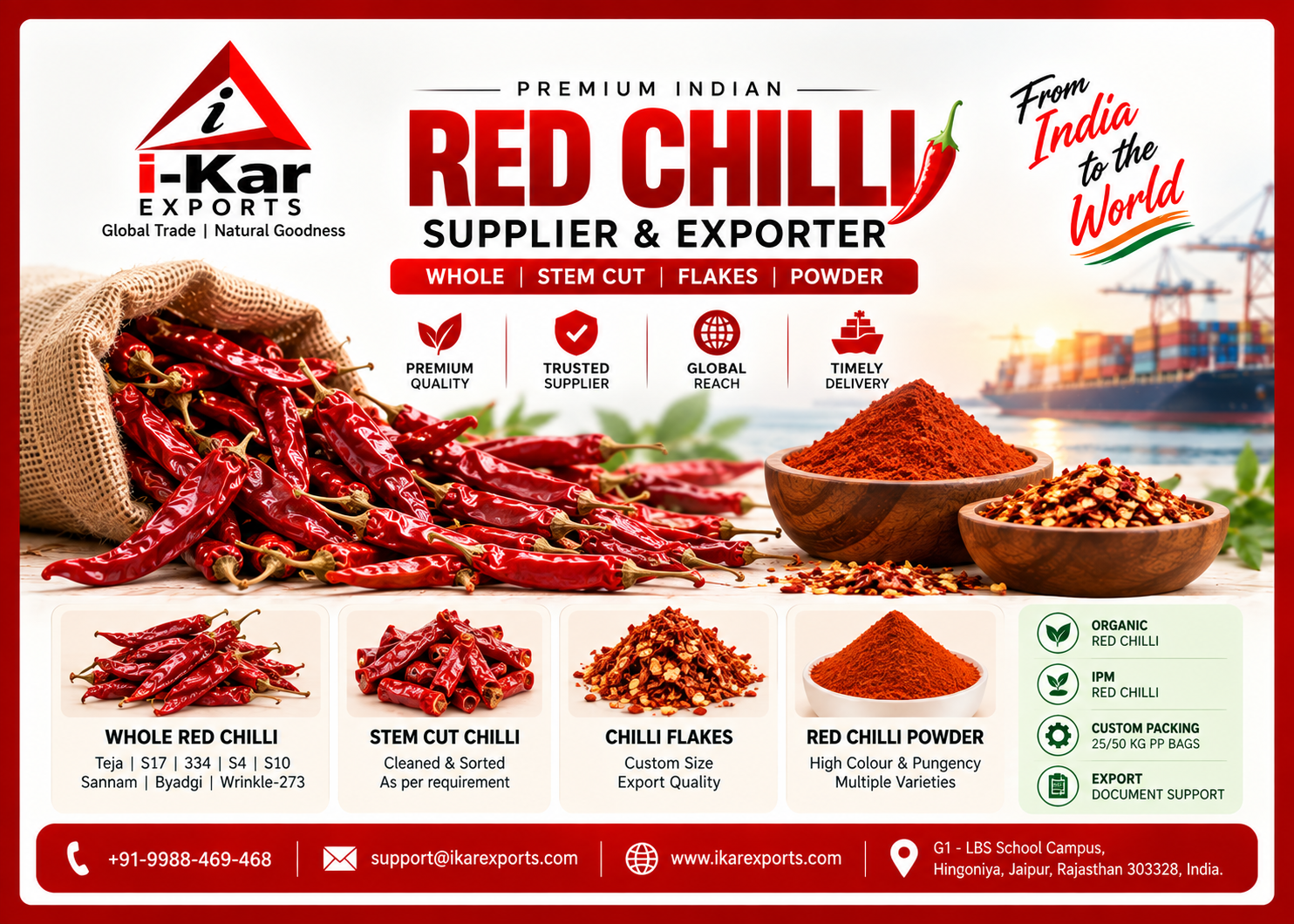
i-Kar Exports offers commercial varieties including:
- Teja S17
- 334 / Sannam
- Byadgi
- Wrinkle Red Chilli
- Other varieties according to buyer requirements
The company focuses on bulk supply, quality inspection, customized packaging and international logistics.
For buyers looking for Indian red chilli, i-Kar Exports can provide product specifications and quotations based on the required variety, quantity, quality parameters and destination.
From Indian Farms to Global Markets
The Indian red chilli supply chain starts with farmers and local markets and moves through collection, drying, grading, cleaning, testing, packaging and international shipping.
At i-Kar Exports, sourcing from established agricultural markets allows buyers to access Indian chilli while receiving support with:
- Product sourcing
- Variety selection
- Quality specifications
- Bulk procurement
- Packaging
- Documentation
- Shipping
- Export logistics
This is particularly useful for overseas wholesalers, spice importers, food manufacturers and distributors looking for consistent Indian chilli supply.
The Outlook for Indian Red Chilli Exports
The 2025–26 production decline may create tighter availability for certain varieties and quality grades. At the same time, India’s established production base, processing ecosystem and international reputation continue to support its position in the global chilli market.
For buyers, the key will be selecting the right variety and specification rather than simply buying based on price.
Factors such as ASTA colour, pungency, moisture, size, cleanliness, pesticide-residue requirements and destination-country regulations can significantly influence the final value of a shipment.
India’s strong domestic production ecosystem and extensive export network make Indian red chilli an important sourcing option for international spice buyers.
Conclusion
India’s estimated red chilli production for 2025–26 is approximately 2.46 million tonnes, according to the latest Spices Board figures. Although production is lower than the previous season, India continues to be a major force in the global chilli trade.
With important production and trading centres such as Guntur, a wide range of commercial varieties and an established export infrastructure, Indian red chilli continues to serve buyers across Asia, Africa, the Middle East, Europe and North America.
For international buyers looking for bulk Indian Teja, Sannam, Byadgi or other dry red chilli varieties, working with an experienced exporter can simplify sourcing, quality control, documentation and logistics.
Looking to import Indian red chilli? Contact i-Kar Exports for bulk requirements, product specifications and export quotations.